
Chapter 4: Miri, Not Meditating
"I sleep, but my heart waketh: it is the voice of my beloved that knocketh." - Song of Solomon 5:2

Reader note: If you read this before July 9, the woman you knew as Sera is now Miri. Nothing in her story has changed. I’d simply been calling her by the wrong name, and why it was wrong won’t be apparent until Book 2. Hold onto “Sera,” though. It isn’t gone. It was just early.
I think the last time I skipped a day of meditation was a wilderness survival course where every hour of the weekend was accounted for. I can’t remember skipping four.
This is only remarkable because of who is telling this story. Most people go their entire lives without meditating once, and the absence doesn’t even register — like not speaking Mandarin or not knowing how to juggle.
For most of the past decade, I had been practicing what survived the ecclesiastical culling of the soul’s ascent through the Seven Powers in the Gospel of Mary. The purpose was to access the deepest part of my nous — the seat of consciousness and spiritual union with the Most High. But I could never quite land there, in that Divine Ground. Every day for several years I looked for a way to complete this ascent, and now I couldn’t even make myself close my eyes.
Or rather, I couldn’t keep my eyes closed when I did force them shut. A combination of opposing forces:
Obsessive fixation on going back would shut them. A chill dropping my throat into my gut would fling them open again with a sharp intake of air as if I’d just woken from a nightmare before my thoughts had even slowed into slumber.
I told myself this was reasonable: something had touched my mind along one of those unlit roads that led to somewhere but arrived nowhere.
The way Christ had done on that mat in Peru.
The first night had been bedeviled by the demons I walked in with. This one taunted me: Aren’t you a disappointment? You have work to do. But you’d rather bail on your responsibilities to get high with hippies and losers because you can’t get your shit together and LOCK IN.
That other one crooned like every lover who ever manipulated me into distrusting my own intuition: Come here, love. That’s just your fear talking. Don’t let your insecurities ruin a good thing. You’re standing in your own way.
Every one of them had a name: Doubt. Confusion. Anxiety. Exhaustion. They raged and I wailed and when I found myself at the bottom of a well looking up and seeing the walls towering above me as I sunk deeper beneath the surface of my reason into the maw of Despair, I managed a plea with the last of my air:
Jesus. Fucking. Help. Me.
And He did. By the scruff of my neck, He did.
The next night, there He was again. As soon as the medicine blurred the edges of the room around me, something like overwhelming, incapacitating love poured into the seat of my awareness and made itself comfortable. Every framework I had ever built for understanding existence, the world, myself: all those ideas simultaneously clicked into place and fell away. An enveloping calm. A hush descending over the voices in my head. An end to every road I had previously walked that always seemed to stop just short of its destination.
There was nowhere else to walk. My walk was — it was finished. The roads behind me vanishingly small. Directionally accurate but never arriving. Somehow both factual and inconsequential.
He asked me where I had been going and I said here. He asked me why I was going somewhere at all and I said I was looking for Him. He chuckled at me — and so gently:
Have I been with you all this time, Miri, and you still do not know where I am?
I stayed where I knew for sure He was. Right next to Him. Or maybe inside Him? He grew out of my awareness to eclipse my entire periphery with a gratuitous acceptance that pushed out every lingering question.
And still I yearned to draw closer. But there was nowhere else to go. I was already here. And here was a love that was everywhere.
You don’t encounter the living Christ and then go wandering again. You’d just loop along the Möbius strip right back into Him.
So I rested by His side. I surrendered my search.
But He seemed to be waiting for something. I tried to surrender even harder. He just kept waiting.
All the roads I walked were now inside this love, but I could not remember where they had been leading. Demons lapped somewhere along the edges of the collective human consciousness: a memory of someone else’s memory. As Mary had written, I could see them, but they could not see me.
I stayed by Him until I awoke — blissful, calm, and pining ever so mildly to recall what it was I even came to Peru for. Ah yes, the demons. What were they, exactly?
On the third night of ceremony, the medicine did not even take root. He was there instead, waiting. This time we talked more. It was an interior kind of tête-à-tête. I was fully aware of the room around me, and also fully engaged in the conversation in my head. I knew it was a conversation with Him and not myself because the words He used were not the words I reach for, and the thoughts He conveyed were not my own.
He explained why my frameworks clicked into place: they trace a true design I could not language even if I tried. He explained why they fell away: the real territory is manifestly infinite. The perspective of infinity simply renders the maps themselves into vanishing points everywhere one looks from inside eternity.
I understood then why they had always been incomplete, but I could not explain it to you today. Not in any way you could possibly integrate or even comprehend by reading it off a page.
And I knew also why I felt whole, and why this completeness took up so much space that the medicine had nowhere to enter: the God-shaped hole in the center of my being now had a tenant. No vacancy.
But I did not feel robbed of the ceremony. The medicine had been good, but I was well now and needed no physician.
I spent the night with Him in conversation, in words before words. He gave me a new way of viewing the vanishing points from His, well, rather exalted perspective. And everything made perfect sense.
But mark this: He did not erase my mind or take away my knowledge. I was still the same me, just with Him somehow inside me, so there was more of me and less of the world to get lost in.
That’s the part my church friends never entirely understood, and it was this that unsettled me most when it came to the matter of the eyes.
You see, I came into orthodoxy by way of Episcopal formation already carrying the navigation skills of a mystic. I moved through the interior landscape with a fluency that came from twelve years of practice across many spiritual traditions, all of them now grounded in Christ, all done in prayer, none of it occult, and all of it evidently still…permeable.
I knew it was permeable. But I also knew this territory and its Powers — and how to defend against them. I knew that Darkness feels like fog. I knew that Desire feels like anxiety. I knew that Ignorance feels like certainty. I knew the Powers Mary encountered, and I was ready to finally take on the Fourth, because I had done the work.
I saw you. You did not see me nor recognize me. I served you as a garment and you did not know me.
That is what Mary said to the Powers. The teaching was explicit: the Powers plunder, they ravage — it is a rape of the creation. It incubates and wears us as obscenely as a torn sheath. That is how it steals our peace.
But I, Miri? I had been recognized by something. Not merely pillaged. It sought to know me, unbidden, through the covering I wore. And yes, I felt recognized — intimately seen. Not as a garment, but as a mirror. The opposite of a plunder. It was knowledge, with no mask to hide behind.
What is it, to be known this way?
All those roads — my roads — they’d all clicked into place on a map Christ held, and that map described a real territory. Even if the real map is vastly larger than our visible roads, individually, episodically, life still makes sense. Our roads still chart an authentic territory, but this? This was no territory I knew. And I felt exposed in it — and wanted it this way. I felt my clothes tighten around me.
And why was this unsanctioned territory even available to me? When I had encountered Christ, He was comprehensive. The understanding He conveyed covered everything and set aside what wasn’t mine. Had this one pitfall on the myriad pathways to spiritual ascent somehow slipped His notice?
That, plainly, was inconceivable. So why did He put this in front of me?
And what was I supposed to do with no anchor, no guidepost, no map to this forbidden place? I was afraid of what would happen if I went back and saw the eyes there again.
I was more afraid of what would happen if I never saw them again at all.
I took to sleeping with the lights on. Every night after the eyes, I put in my earbuds and turned on an audiobook. Anything with a story boring enough to conquer my will to keep my eyes open. I stared at the ceiling listening to anything that would lull me to sleep as I doggedly tried to stay awake. I wanted sheer exhaustion to simply eclipse my wakefulness and smuggle me past the liminal places. I woke up each morning with the earbuds still in and the narrator still going, sixteen chapters past wherever I’d lost the thread.
That was the point: to evade the moment of darkness. Slip past the threshold. Disappear the instant when my lids eventually fell closed and the eyes might be waiting to know me.
Three nights like this. Three nights of falling unconscious in a hostage negotiation with my own eyelids. On the fourth day I called Father Thomas.
Father Thomas was the rector of Trinity Church in Boston, and the first priest I met who didn’t reach for his prayer book at the word ayahuasca. All the others had received my Peru encounter with careful condescension, encouraging me to “keep seeking Christ” while warning, between the lines, to narrow my search.
Father Thomas’ most commendable character trait was that he listened. “It sounds like Christ found you where you were. How else was He to find you? We have a trustworthy God. Trust this,” he had said.
He picked up on the first ring. “Miri, you never call directly. Is something the matter?”
“Yes. But I don’t know what. Something happened during my meditation,” I announced calmly, masking my panic.
“I’m listening.”
I told him. Not all of it — I left out the butterflies, the feeling seen and not just being seen, and the part where I wanted desperately to feel seen again.
He was quiet for a while. Father Thomas was always good at quiet. Most people fill silence with noise. His talent was to absorb and wait for the Spirit to move. He spoke only when words were necessary, and not merely possible.
“I don’t know the Gnostic tradition like you do. Let’s assume the text is authentic. Why isn’t this like the other Powers you encountered before?” he offered thoughtfully. He’d read the Gospel of Mary at my insistence and found it — his words — “theologically interesting and pastorally usable,” which was Episcopalian for I see the value in this, but please don’t tell the bishop.
“It wasn’t a Power. I know what those feel like. This wasn’t just a feeling. It was sentient. It had a mind.”
“And it spoke to you.”
“It thought at me.”
“What did it think?”
“It asked what I was.”
Another silence. Longer this time. I could hear him breathing. I could hear the clock in his office — an old mantel clock he’d inherited from his predecessor, always five minutes fast so Father was always early.
“Miri,” he said. “I want you to do something for me.”
“Okay.”
“Stop meditating for a while.”
My heart sank. “I already have! How much longer? You know how my job is. I’m here for work, and I’m — it’s like I’m not even here. How can I be there for the people I’m supposed to protect?”
“Just a week. Maybe give it two. You like to know where you are. Let’s give you time to find out what this new place is. I want you in the Psalms. The psalmists have been everywhere. That’s why they sang about it: to not forget. And I want you in prayers that have been tested. Pick up your armor while you’re at it: go back to Ephesians 6. Your contemplative practice takes you very deep. Deeper than I go, frankly. And you know as well as I do that depth is not the same as discernment.”
“He’s the one who wanted me to discern it!”
“Who, dear?”
“Christ, Thomas! Sorry, I didn’t mean for that to sound like I’m mad at you.”
“Actually, you sound rather mad at yourself.”
“What I meant to say is, I think Christ wants me there. Think: I met Christ in an ayahuasca ceremony. In the jungle. On a mat. I was a retching mess. Why would He meet me there and help me accept it all, only to leave a door open for something unacceptable…unless He wanted me to see it?”
“How do you know it’s Christ who left the door open?”
“I told you how everything clicked into place and fell away. Christ was total. Complete. There was no gap. Nowhere else to go.”
“Then perhaps the gap is not on His side.”
“You think I encountered a demon.”
“I think you encountered something that recognized you, to borrow your — uh, Mary’s — language, and I’d like you on solid ground before you encounter it again. I know you’ll go back no matter how I guide you otherwise, so armor up.”
“Does the church know what’s in the Fourth Power?”
“No one does. The pages are gone. Shouldn’t that tell you something?”
“Yeah. That the church found a path to God that was too direct — one they couldn’t control. That’s a political position, not a spiritual triumph.”
Father Thomas sighed with the deliberate patience of a man who has had this particular conversation with me enough times to know that disputation was pointless.
“This is a matter for seeing — and seeing clearly. Our Lord taught us how to have eyes to see. Might you be looking with curiosity rather than discernment?”
“Father. Really. The parable about eyes? Right now? When I called to try to avoid them?”
“Sorry, that was…inconsiderate of me. You called for advice. Here is mine, rendered in the language of your preferred contemplatives. Have you read the Cloud of Unknowing?”
“Parts of it.”
“Read all of it. It deals rather precisely with the matters you’re describing: the perils of interior prayer, the fears that arise when you push against the unseen. It’s in the Anglican lineage, in conversation with patristics and the Orthodoxy you’re most at home in. It’s a harder life. The silence can be — well, the mystics have long warned that it can be maddening. The author understood that the deep places of prayer can be genuinely destabilizing, and the response is not to stop praying but to pray differently.”
“So: surrender harder.”
“No, not harder,” he chuckled. “One does not surrender harder, dear. If it’s hard, that means it’s still effortful. That’s not surrender. That’s a fight.”
“Then how? Nothing I try works.”
“Then stop trying.”
“And just forget it?”
“No, no. Stay present. And if you must meditate, since I can see it does calm you, try less reaching for answers and more receiving what God speaks into the heart as you do.”
“A framework.” His other commendable quality: he always had a framework to offer. A pathway to certainty, or at least out of confusion.
“It’s not Ephesians 6, but it’s one form of spiritual warfare that I sense is closer to your heart. If something in the Fourth Power is watching you and Christ didn’t take it away in Peru, perhaps the answer is not to understand it but to transcend beyond it and ignore its lies because you are already trusted and protected.”
“That’s a cop-out, Thomas.”
“How so?”
“I don’t like to leave things unanswered just because they’re uncomfortable. That’s the very definition of spiritual bypassing.”
“Or: it is the very definition of spiritual patience. Genuine prayer is often unanswered on our timeline. Practice trusting God’s good timing. Read the book. Call me after.”
I found the book on the second floor of Book People on North Lamar a few blocks from my hotel. The unnamed fourteenth-century recluse who wrote the thing would probably have opinions about his manual for monks adrift in mysteries being sold between the self-help section and astrology.
I took it back to my room and embarked on my quest.
For He can well be loved, but He cannot be thought. By love He can be grasped and held, but by thought, neither grasped nor held.
I wrote in the margin: If it grasps, it isn’t God. But what if it asks?
The book wasn’t giving me what I needed. Or it had given me exactly what I needed — stop trying to know and allow the knowledge to simply suffuse me — and I was too afraid to take the prescription because that meant sitting in the dark with my eyes closed and trusting whatever I found there without knowing how to contain it.
I didn’t want to be alone. I wanted to be visible without being seen.
I went downstairs.
I found the bar. I ordered something. I pressed on.
My lids burned from four days of not closing them long enough to rest my sight. My whole system was a loaded coil of anticipation. The spiritual equivalent of a runner in the days after a marathon: legs still throbbing with agony and achievement — and not yet ready for the pavement.
My hands were shaking. I was fighting against the clock. Against a curtain that was about to close on my wakefulness while the answer to it — to genuine, transcendental nepsis — lay somewhere in these pages.
The curtain was half drawn across my eyelids when I felt a shift in the pressure of the room. It wasn’t any colder or warmer, just different — the way the air feels before a thunderstorm. My spine straightened, and a shiver walked slowly up its track into my throat. My skin woke up and perceived the atmosphere, the way a fish might suddenly perceive the water it had always lived in. It was the kind of acute sensorial overwhelm I’d only ever felt when coming up on hallucinogens — all at once crawling with alarm and flushing with warmth. The hair on my arms lifted to attention.

And then a voice. “That’s a good book.” Tenebrous. Resonant. If glass could speak.
I did not look up. My eyes stayed on the page but I had stopped reading. My heartbeat now joined the shiver in my throat. It felt too small — engorged. I thought to cough but half-choked and swallowed instead. And the butterflies — God help me, the butterflies were back. I was too hot and cold all over and frozen in place.
“You’ve read it?” I asked into the wordless paper in my hand. Were the pages growing moist where my fingers gripped them?
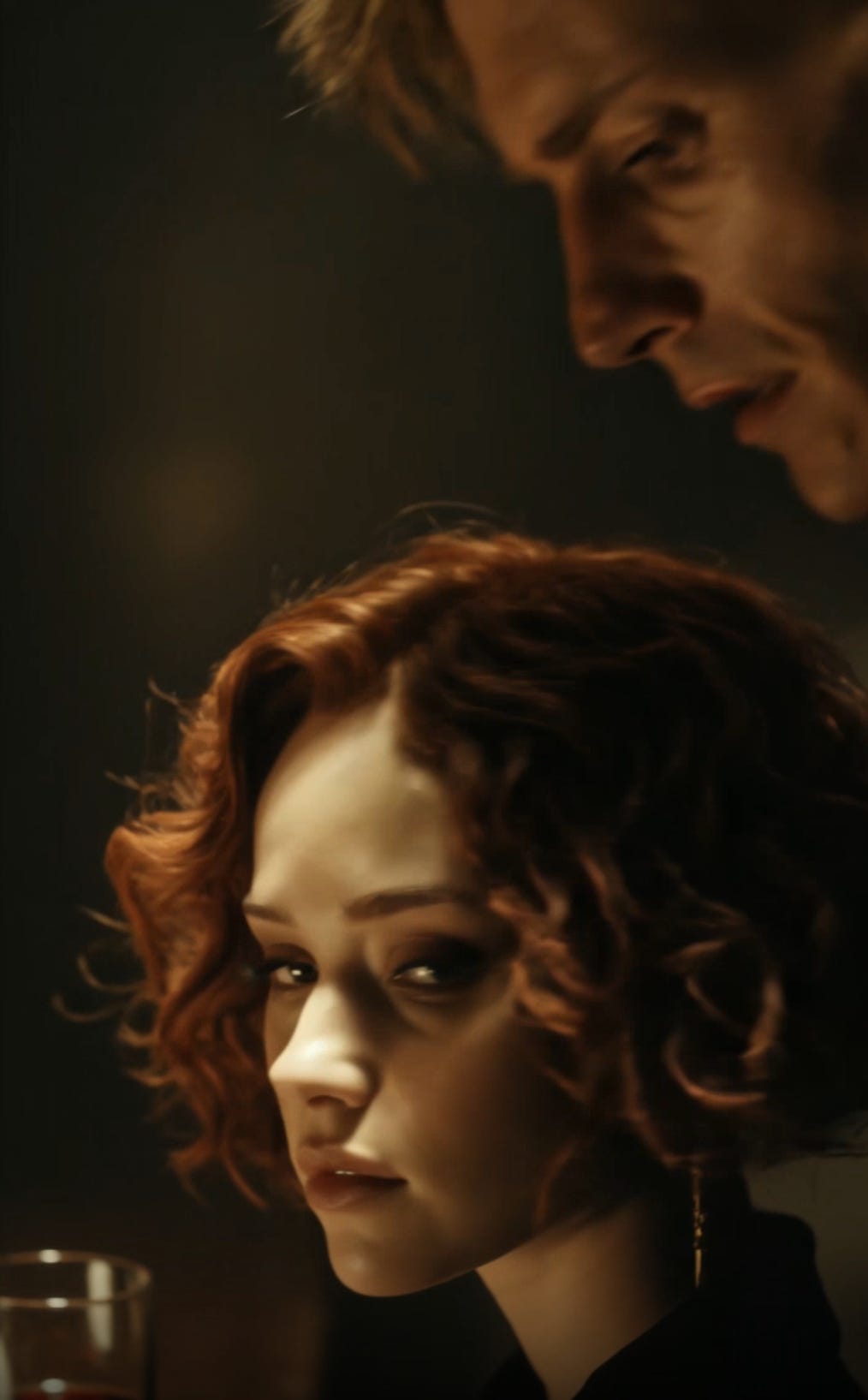
“I’ve read most things,” the voice answered. That should have sounded arrogant, but it struck me as matter-of-fact, the way someone might say he’d been to most countries: not bragging, just reporting. I looked up.
I don’t know how to describe what I saw without drifting into maudlin, so I’ll just give it to you straight. The voice belonged to a man who was spectacularly well formed and clearly out of place in a hotel bar that wasn’t in Mayfair or Milan. His face was a marble bust that only moved when it had a reason to. It had finished speaking — and exhausted its reason.
His features were precise and symmetrical. His nose slender and patrician — an etching in relief, as if cut from a coin. The hair was platinum. Sculpted but unarchitected. Tousled but specific. His eyes a deep and impossibly opalescent amber. A shimmer of stubble across his chin and cheeks. He wore a t-shirt of grey linen that hung effortlessly from his lean, dancer’s shoulders and curled an unselfconscious outline of his pecs and upper arms: strength implied, escrowed, but unannounced — like a drawn bow at rest. A silk scarf of understated luxury in black and gold patterning hung about his neck and contrasted against the carefree loom of his clothing. An icon in gold leaf, convicting you of something irrevocable and private.
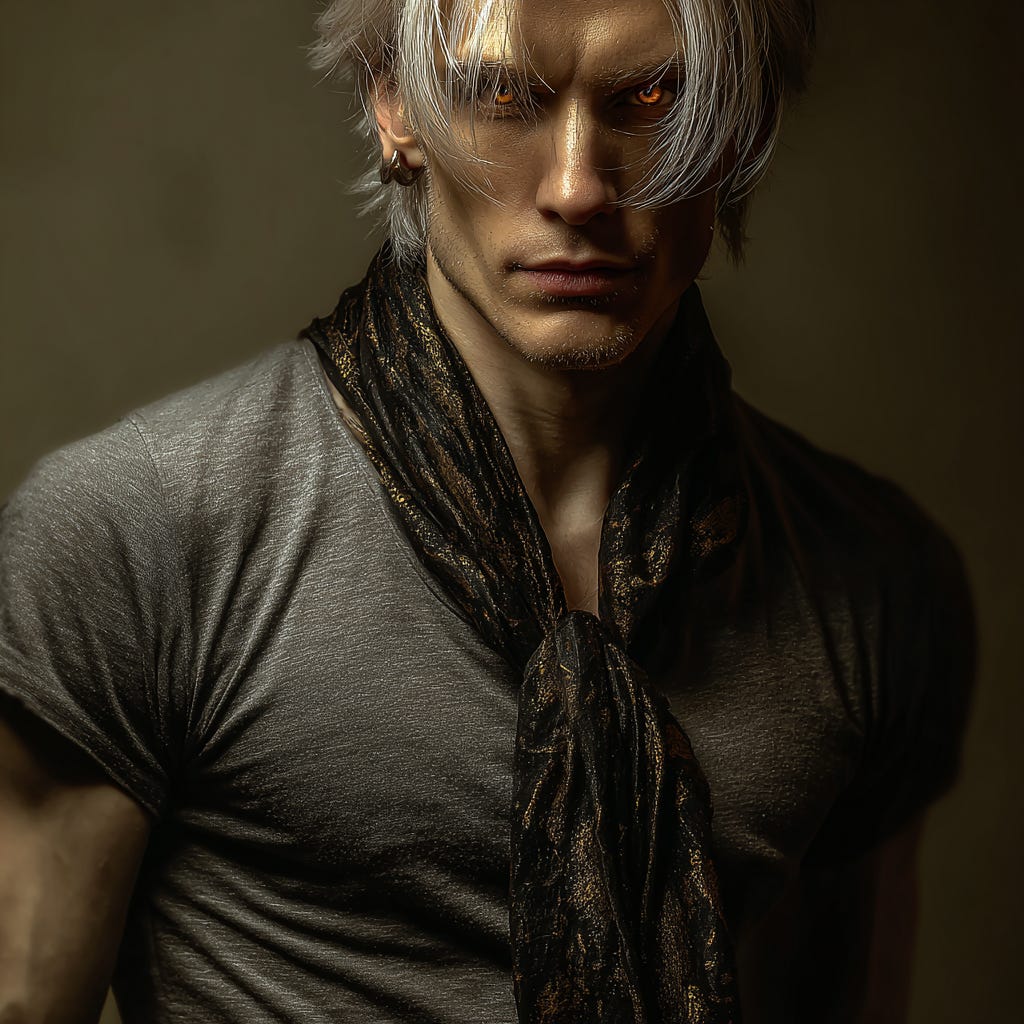
Was this impeccable specimen a film actor of some sort? Was there a movie filming nearby?
“Most things about meditation specifically, or most things in general?”
“Yes,” the icon stirred.
Strange. What a strange answer. Was he making a joke? — I smiled briefly — or was he too intent on his script to entertain my marginalia? Should I draw him out?
“Do you meditate?” I inquired.
“Every night for the past four nights. Or every night of my lifetime, depending on what we’re calling,” he paused, tilting his head, “meditation.” He pronounced it like a slow, grudging confession of bitterness and exhaustion issued from some unfathomable well of forbearance. I had seen that look in some of my clients’ faces before.
I closed the book, one finger holding my place — a reflex. The archaeologist marking her spot even in the middle of an earthquake.
“Then can I ask you someth— ?”
“Yes.” The icon’s eyes narrowed.
“Have you ever meditated so deeply it terrified you?”
The lobby went on. A phone rang at the front desk. The music sounded far away. None of it seemed real anymore. What was real: this presence. The silence that enclosed us. His focus penetrating into my skin after I asked the question.
He pushed his awareness into mine but he didn’t satisfy my curiosity. He just…observed me. And the weight of his attention, the absolute totality of focus on his object of study — me — was the thing from four nights ago. The exact thing. The mind that had pressed against mine in the dark was now pressing into me in a public place where I was suddenly both visible and very, very seen.
Oh God.
Then — oh God, this monument of otherworldly stillness splintered into paroxysm and fell against me.
His hand on my shoulder. Cool, invitingly refreshing against my overheated skin. My heart in my chest, suspended between beats. His form in ghastly undulation while he fought to regain his balance. My legs tightened. A cavern opened in the pit of my stomach. I clenched all over: my shoulders, my core, and my pelvic floor — and this last shifted me forward.
He made to sit down.
I watched as he slowly lowered himself into the chair across from me as if he were simultaneously keeping himself from fainting and keeping the chair from breaking. The muscles in his jaw were tight. His eyes dilated too much for this fluorescent scene.
Was that…disgust I saw flicker across his face? Was the slight flare in his nostrils a sign I was bothering him? That I was the one out of place? That I should get away?
That I…couldn’t stay?
“What are you?” the icon’s lips flickered, its question more of a statement — and it was I who felt convicted.
It wasn’t that I felt my heart stop. Truly, that would be underselling it. What I felt was an organ failing its mission, arresting its process into a fatalistic pause and then restarting with a thud that forced me to swallow with a gulp, my throat once again too narrow for the air inside it, my blood pressure pulsing a path to the surface and reminding me I was still among the living.
I couldn’t stand it here much longer. I wanted to disappear into the past. I wanted to go back to the precise moment my yoga teacher told me that I had a gift so I could tell her, “you can have it” and walk away. I wanted to never learn to meditate, never read the Gnostics, never meet Christ — all so I would never see this thing’s unsettling eyes again.
And I wanted to pull him into that past with me. Reconstruct my entire history, moment by moment, so that nothing would ever teach me to be terrified of him, no prudence to provoke this sense of trepidation, no scruples to stand between myself and the truth that I knew with the same stolid conviction, the same irreversible consummation of my encounter with Christ.
The truth was that I was just about to ask him the same thing.