Chapter 13: Miri Holds the Line
“In the day when I call, answer me speedily. For my days are consumed like smoke, and my bones are burned. My heart is smitten and withered like grass; so that I forget to eat my bread.” - Psalm 102:1

Songbird was her codename.
No real name, which was by design. A clipped, foreign-accented English — likely Russian or Ukrainian — with occasional grammatical errors and characteristic absence of definite and indefinite articles.
That’s all we knew of her, and this was by design: data minimization. Protective.
But what she gave had been far more valuable than her identity.
The information came piecemeal: a phone call here and there with an address or descriptions of her captors. A text from an unknown number that moved too fast to triangulate location. The mention of a private jet.
With enough data points, the DHS team had been able to narrow down the perimeter, at least for the past three weeks.
On Saturday, teams were onsite at every private landing strip in central Texas with a representative from Lantern attached to each crew. They were looking for twelve women and an unspecified number of suspects.
The way she communicated had rules: no cops on the line. No law enforcement. She only spoke to Callum or me, ever since the first call came in to the hotline number from an untraceable location. This made things difficult for everyone involved, but we were in no place to dictate terms. So Callum and I had been on call for months, picking up every unknown number that came in — even the spam ones. We waited and we answered everyone indiscriminately, ready to patch in the task force whenever Songbird made contact.
I spent Saturday by my desk phone at my office on Meridian Street, using my cell to coordinate logistics with my aftercare staff while awaiting news from the ground operation. What nationalities do we anticipate? How many women might be recovered? Are counsel and counselors onsite?
By three p.m., Alina still had no news.
A text came in: “Didn’t want to wake you or interfere. Wishing you the best. Yours, Simeon.”
By five, I was nervous and had chipped the polish off my nails when the desk phone finally rang. Three suspects apprehended: two male and one female. Eleven women recovered at Pecan Bluff Airstrip in Bastrop. Only eleven.
And all denied making any contact. So none of them were Songbird.
I kept my focus on the outstanding items on my list with a pit in my stomach: how many women need ongoing medical care? How many might be shipped to Boston? Is the parish coordinating interfaith support? Are our host residences still ready and willing to take in survivors?
And where was she?
I shot off an SMS: “Thx. For the sleep. Things took a turn. Talk later,” and went back to eviscerating my nails.
“Here for whatever you need. Yours, Simeon.”
At 21:22, my cell phone rang.
Unknown number. I had the headset on before the second ring and my voice already down in the register we trained: low, slow, no questions in the first sentence.
“Free Harbor. This is Miri.”
Breathing. Clanging sounds. A honk.
Then, in a whisper: “Listen. Fast. Got moved. Thursday. Van, before sunlight. Not where map says.”
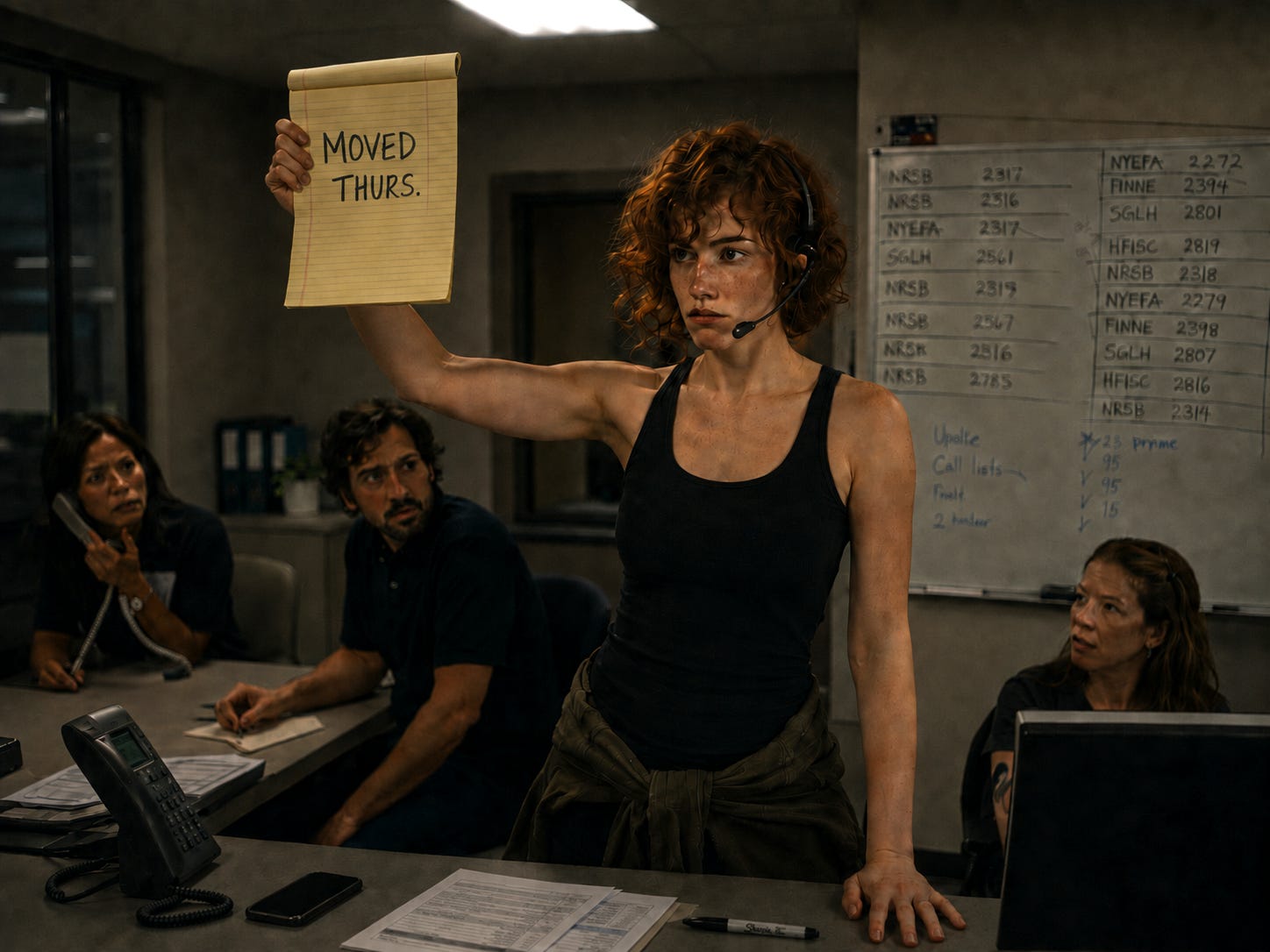
My hand went up. Across the floor, heads turned. I wrote MOVED THURS on the legal pad and held it toward the room, and someone was already relaying to Alina’s channel, and the voice was still going, quiet and even, like a woman reading ingredients to herself while the kitchen burned.
“Do not call off day. You listen? Others still there. Don’t let them change.”
“They’re safe. It’s over. Eleven women. Where are you?”
“North. They drove.” The street noise got louder. “Long bridge. Water. There was sign for—”
The line died at 21:26.
I sat with my hand flat on the desk while the relay channel barked orders I almost didn’t hear.
Someone else took down instructions. The call was recorded, as all of them were. By Monday the audio would be with a forensic tech in Houston who could tell you the make of a truck from its engine noise and whether the voice was the same across all previous logs, but who would not be able to tell me her name.
I kept the headset on until three in the morning, monitoring a line that did not ring.
Somewhere toward four, I understood what I was doing, because I had heard it described, in the armchair in my living room, in an accounting so grave I’d wanted to laugh until I could only scream. Sitting at the edge of a dark, tuned to exactly one frequency, waiting for a signal to come online and refusing to be anything less than adamant.
And before that. In Austin. Four nights, he’d said. He lay in a barren garden for four nights, waiting for a light.
The sun found me at the desk, but the line stayed dark. I finally understood the difference between his kind of waiting and mine. Simeon at least knew what the silence was: I was unavailable. Mine could mean a dead battery, or a van still northbound, or a dead girl.
Sunday was supposed to be a day off, a concept that had by then become as debatable as string theory. I crawled home and slept three hours.
The whiteboard in our operations room held twelve case codes, and beside the twelfth, in marker, one word that was not in code.
Ghosted. Again. And this one felt like helplessness, not heartbreak.
The morning brought with it paperwork and a body count. Eleven intake packets opening in Austin. Eleven people with no names, medical clears, first meals, clean showers, and the translator rotation alive on overtime.
Three calls punctuated the day. The first was Callum, morning, his voice hoarse from running an intake site on five hours of sleep. Eleven women were eating in the cafeteria adjacent to his conference room. N-7 had accepted a second helping at breakfast and said nothing — which, in the metrics that mattered that week, counted as a landslide.
His people gently worked the open door using interpreters. Never an interrogation, just: is there anything you want us to know? — and two of the women, independently, described the same person. The one who whispered to the drivers and came back with a warm smile and papers with new ink on them. The one who was there Wednesday and gone Thursday.
The briefing later was the after-action review on Webex, regulation beige, with Callum’s face in one square and Alina’s in another. I finally said the thing I had been circling since 21:26 the night before.
“Who knew about Thursday?”
Alina did not look up from her notes. “Excuse me?”
“The rotation. They moved her thirty-six hours before a sealed operation. The schedule was sealed. Vans don’t move on coincidence.”
“Vans move on Thursdays and all days, Miri. That is what vans do.” She looked up. A look flashed across her face too fast to read: weariness, or maybe a warning. “This wasn’t a leak, if that’s what you’re implying. The source was never in our custody. We can’t lose what we never had.”
Callum, in his square, was doing his usual: studying his coffee like it had subtitles. Alina moved to the next item. Confirmed the women would begin arriving midweek.
That evening, still in the office, I stared at my cell and took the only action I could: I typed a message.
“Got 11. There were supposed to be 12. The one who built it all got moved. She called, but her line went dead. I feel like shit.”
The typing indicator started before I hit send, so he must have been holding the phone.
“I’m very sorry, Miri. Do you need anything? Yours, Simeon.”
I did not answer, but I read it four times. Then I placed a call to Father Thomas.
“Who am I praying for tonight, Miri?”
“Songbird. The line went dead. We only got the others. I don’t know if she’s alive. And I don’t know her real name.”
“Then I’ll pray for Songbird,” he said. “God can do the crosswalk.”
“How’s the prep going? Are the families ready?”
“We have fourteen homes waiting for visitors. How many are we expecting?”
“One less than enough. Eleven at most. Not all of them will go to Boston. And Thomas? Thank you.”
Sunday night, my apartment, 11 p.m. Seven nights since a knight in a cashmere longcoat stood at my threshold and asked to come in. One night of real sleep in the seven. Eleven women in bed behind doors that lock from their own side.
And one voice, somewhere north of a long bridge, over water. Hopefully still singing.
I set the phone to charge face up on the pillow beside me, ringer on, screen locked.
I stared at the ceiling in the dark. Then I reached over.
“Take me to breakfast tomorrow.”
“I’ll be there at nine. Yours, Simeon.”